
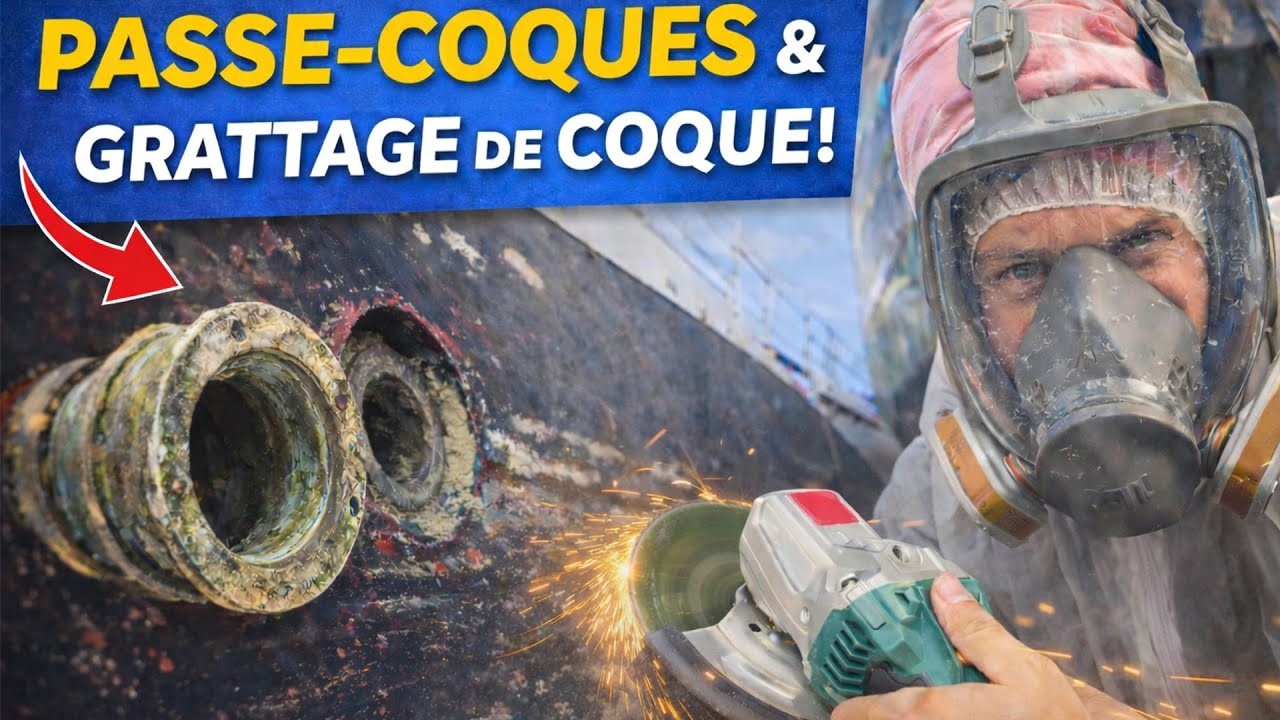
The video is in French. The whole job is written up in English below.
There is work that shows, that is rewarding, almost “instagrammable”. And then there is the work nobody ever sees… that can decide the fate of a boat.
That weekend, on CQS Evidence, our 1979 Mikado, we started on an essential job: taking out the skin fittings and the seacocks. What we found reminded us of something simple: on a sailboat, safety starts below the waterline.
⚓️ Skin fittings: small parts, enormous responsibility
What is a skin fitting? Quite simply an opening straight through the hull that lets water in or out:
- sink drains
- heads
- engine water intake
- cockpit drains
- and so on
Each skin fitting has a seacock on it, which lets you shut the water off.
They are literally holes in the boat. And when you are sailing, they are below the waterline.
If a skin fitting breaks or cracks, or a seacock gives way, water comes in. And it comes in fast.
That is why skin fittings are treated as major items of safety equipment on a sailboat.
🔍 The state of ours: corrosion, and concern
Taking the first seacocks off, we realised we had been right not to wait.
The parts were:
- rusted,
- marked by time,
- and some of them badly corroded.
On a 1979 boat like ours, with a GRP hull but all the original skin fittings and seacocks in metal, that sort of surprise is sadly not rare: it is not the hull that ages badly, it is the parts that go through it, attacked by decades of damp, salt water and electrolysis.
Some seacocks were stiff to work. Others showed clear signs of metal fatigue.
And that is when you realise something fairly simple: this is not a question of appearance. It is a question of safety.
A weakened skin fitting can become a critical point of failure. And at sea, you do not want any doubt about that kind of component.
🔧 Taking them out: not simple, but necessary
Removing skin fittings several decades old is not a quick job.
Between:
- the oxidation,
- the seized threads,
- the seals glued in place by time,
- and access that is sometimes awkward,
it took patience.
But every part that came out was a relief. One source of risk removed. Back onto sound ground.
🛠️ Sanding and preparation: starting from a clean base
Once the skin fittings were out, we carried on preparing the hull.
On the list:
- sanding the areas concerned,
- cleaning,
- inspecting the surfaces.
On an old sailboat, nothing is ever perfectly simple. Every layer you take off tells you about a period in the boat’s life.
But this groundwork is essential if you want to:
- make the boat dependable,
- prepare a refit that lasts,
- avoid nasty surprises under way.
⚠️ Why skin fittings are an absolute point of vigilance on an old sailboat
Many owners put this job off because it does not show. And yet it is one of the first things to check when buying a sailboat.
Over time:
- brass can dezincify,
- steel parts can rust,
- seacocks can seize,
- electrolysis can weaken the metals.
A skin fitting in poor condition can give way without warning.
And unlike an electrical fault or a cosmetic problem, a leak below the waterline is an immediate emergency.
On CQS Evidence we made a clear choice: we would rather replace too early than too late.
🌊 Building confidence before building the voyage
That weekend was not spectacular. No open sea, no full sails, no cinematic sunset.
But it was a founding weekend.
Because sailing far is not only about dreaming. It is about making sure every critical component is dependable.
Taking those corroded skin fittings out, we did not just remove some metal parts. We made the boat safer. We laid one more brick in the project.
⛵️ Step by step
Our aim is not to set off across oceans tomorrow. It is to build a safe, solid, coherent boat.
Clear out. Modernise the electrics. Replace the critical parts. Prepare the hull.
Every weekend of work brings us closer to a more dependable boat. And to calmer sailing.
Because in the end, real freedom at sea starts with safety.
The full ten-step method, with the parts and the costs, is in the guide: replacing the skin fittings and seacocks on an old sailboat.