
Sizing tool
Your electrical system sized, from the battery bank to the cable gauge
You enter your appliances, your charging sources and the autonomy you want to hold. The tool works out the bank capacity, picks the matching Victron hardware, sizes the protection and gives you the cable gauges run by run.
Free during the launch phase. Instant result, PDF to take to the yard.
The problem
Rewiring a boat is not choosing a battery. It is making a dozen interdependent decisions hold together: the capacity depends on the consumption and the autonomy you want, the charging power depends on the capacity, the cable gauge depends on the current and the distance, the fuses depend on the gauge. Change one parameter and everything moves.
The result: either you oversize “to be on the safe side” and pay twice over, or you undersize and find out at sea. The undersized cable gives no warning — it just gets hot.
How it works
Seven steps. Allow twenty minutes if you have the list of your appliances to hand.
- The system. 12, 24 or 48 V, length of the boat, battery chemistry — lithium or lead-acid.
- The bank layout. House, engine, and a forward bank for the windlass and bow thruster. Each is sized separately.
- The loads. Every appliance: power, quantity, hours of use per day. Fridge, freezer, autopilot, radar, VHF, watermaker…
- The charging sources. Alternator, solar panels with real sunshine figures, shore power and the amperage available.
- The autonomy you want. How many days without recharging. That is the number that does or does not blow up the size of the bank.
- The layout of the boat. You place each load on the plan. That is what gives the real cable lengths, and therefore the real gauges.
- The sizing. The schematic, the hardware, the protection, the gauges and the PDF.
What you get
Free
- The consumption budget, in Wh and Ah per day
- The bank capacity needed for the autonomy you want
- The charging power to install
€20 incl. VAT — the full pack
- The schematic of the three banks and how they link
- The Victron parts list: MultiPlus, MPPT regulator, SmartShunt, Orion-Tr Smart DC-DC chargers, Cerbo GX monitoring — the exact part numbers, not product families
- The protection: the rating of every fuse, run by run
- The cable gauges worked out on your real lengths, and the total length to order per size
- The PDF, to take to the yard or send to your electrician
What is behind the calculation
Nothing magic, and nothing hidden. The cable gauges come out of the standard voltage-drop calculation — twice the length, the resistivity of copper, the real current — then are rounded up to the next standard size. Fuses are rated at 1.25 times the current and rounded up to the next standard rating. The depth of discharge used is 80% for lithium and 50% for lead-acid: that is what separates a stated capacity from a usable one.
The forward bank is worked out on the peak current of the windlass and the thruster, not on an average draw — it is a short, violent load, and it is not sized like the rest.
What the tool is not
It is a sizing aid, not a regulatory study and no substitute for a professional. The results rest on the values you enter: a badly estimated consumption gives a badly sized bank. An electrical installation on board is a matter of personal safety — have your schematic reviewed before you order, and have the work inspected. The installation remains your responsibility.
If you would rather talk it through
The tool gives you numbers. It will not tell you whether putting the bank under the forward berth is a good idea, nor how to get 50 mm² through a run meant for 10.
Sizing call — 1 hour, €100 incl. VAT. We go through your configuration together, discuss where things should go, the constraints of your boat and the order of works. Over video, with your schematic in front of us.
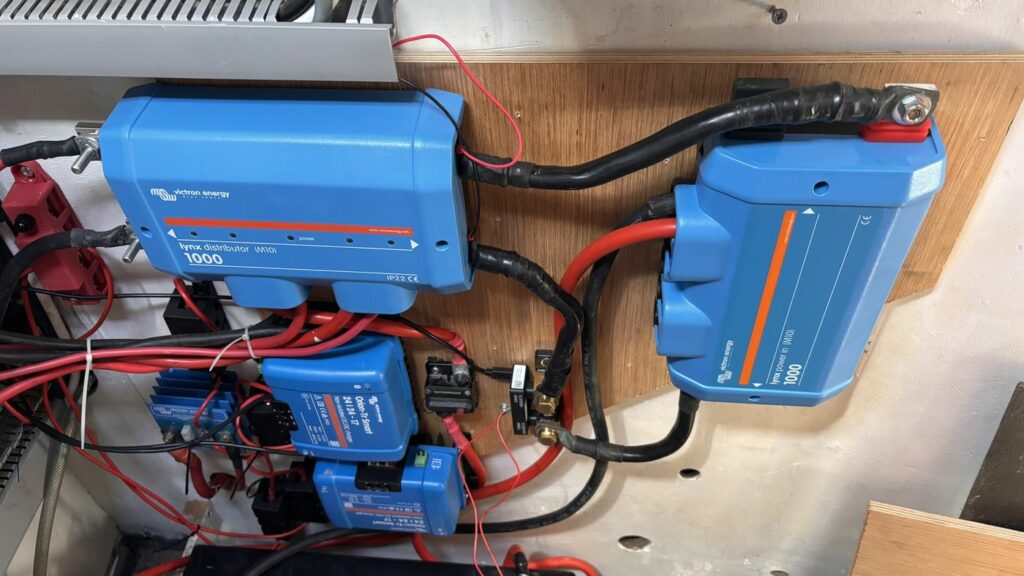
I am an engineer, and I rewired the 24 V system on my own 16-metre ketch — lithium batteries, regulated alternator, DC-DC chargers, monitoring. The job is written up here, mistakes included.
The first 10: everything free
The tool is new. Before charging for it, I want to put it up against real boats — yours. The first ten people to sign up get the full pack and the hour-long call for nothing, in exchange for honest feedback: what is missing, what is wrong, what does not make sense. The move to paid — €20 incl. VAT for the pack, €100 incl. VAT for the call — comes afterwards.
The tool
Seven steps, about twenty minutes. Nothing is stored: your data stays in your browser. The tool’s own interface is still in French — an English version is on its way. The figures, units and part numbers are the same in both.
Transparency on links. The hardware the tool suggests links through to SVB Marine, a partner of the project, who supply part of the equipment for the refit. That does not influence the calculations: the powers, the capacities and the cable gauges follow from your data, not from a catalogue. You can buy the same hardware wherever you like.