
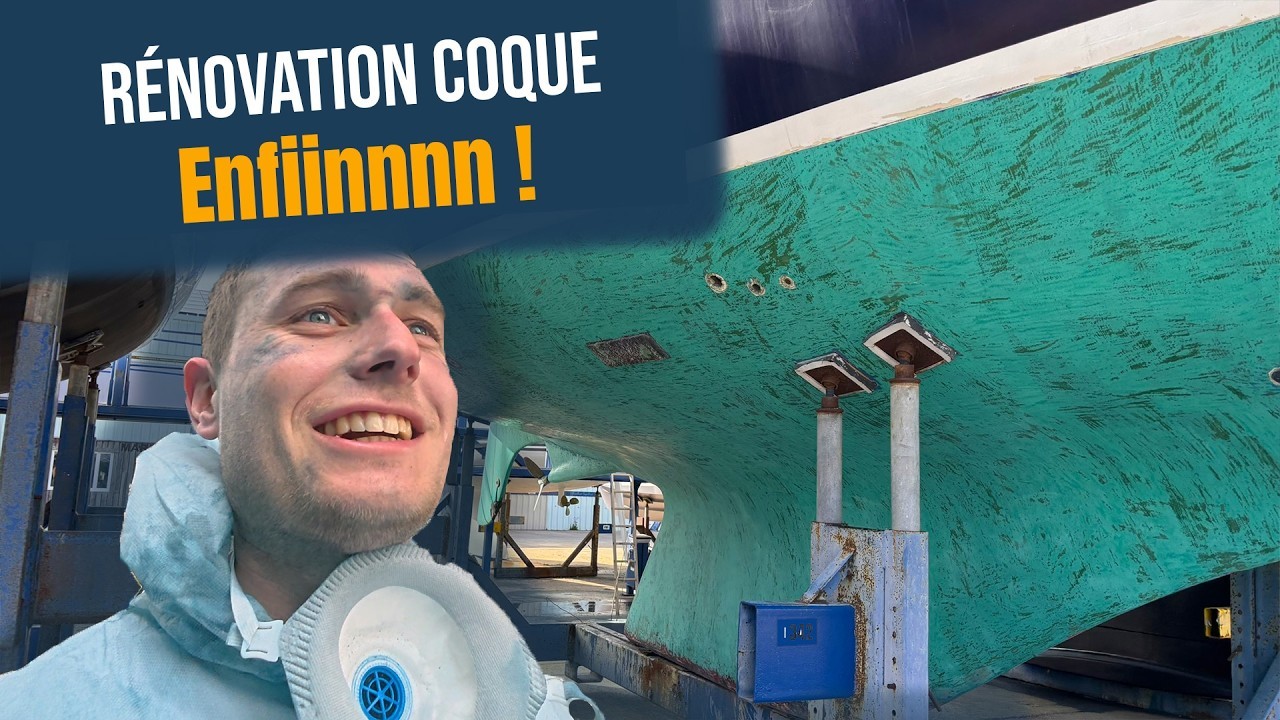
The video is in French. The whole job is written up in English below.
There are weekends where you make progress. And there are weekends where you finish.
That one was a finishing weekend. The end of scraping the antifouling off the Mikado’s hull, a job I had been dragging out for weeks, piece by piece, side by side. This time I had decided: I was not going home without seeing the end of it.
Friday evening, alone on board
I get there at eight on the Friday. Lucas is away this weekend. Pasta with butter, the meal of the unbothered, and I take stock. The hull is waiting for me. Taunting me, even.
The plan is simple on paper: scrape on Saturday, sand on Sunday morning, leave with something clean behind me. Except it is going to rain. There is wind. And I am probably coming down with something.
Never mind. We go anyway.
Saturday: eight hours of scraping in the rain
Five in the morning on Sunday is the F1 Grand Prix. So on Saturday I sleep well, eat well, and scrape as much as I can.
I start with the hardest part — the high area, arms above my shoulders, an awkward scraping angle. The logic is to do the worst of it while you still have energy. The lower part is easier to get at, the angle is good, it goes faster. I save that for when my arms start to give out.
By 11:30 I have put in two and a half hours on a decent area. It is raining. I carry on. In the afternoon I take on the stern and the propeller boss, geometrically the most miserable areas. At 18:18 the stern is done.
Tally for the day: about eight hours of scraping. Bruises on my arms, mosquitoes, intermittent cold rain, and a hull three-quarters bare. Back to the boat, shower, crisps, something on a screen, bed.
Sunday, 5 a.m.: F1, then back into it
The alarm goes off for the Grand Prix. I half fall asleep again. At eight I eat something and go back out.
The bow section is left — the toughest, from what I saw the day before. The blue holds on harder here. The wind gets up, a storm is forecast. I speed up.
At 11:10, it is finished.
I stand back to look at the whole hull. No antifouling. The laminate is there, bare, over the whole length of the boat. It is one of those moments when you want to say a rude word very loudly and very clearly.
What it actually changes
A fully scraped hull is not just a cosmetic stage. It is the condition for everything that follows: the osmosis treatment, the epoxy, and then fitting the Finsulate. As long as the antifouling is there, nothing clean can be done underneath.
I also used the weekend to take out the galley skin fitting — it had to go so I could scrape properly in that area. Next week the aim is to come back with epoxy filler to fill the old housing, and prepare for the new one. The epoxy follows after that.
What this weekend taught me (again)
Working alone on a big physical job is as much a mental exercise as a physical one. Nobody there to spur you on, nobody to take over. Just the work in front of you and the question of whether you are the sort who finishes what they start.
This weekend, I have the answer.
Next time we meet here, we move on to something else. The hull is behind us.