
The video is in French. The whole job is written up in English below.
Mid-September, a week planned on board, Monday to Friday. It stopped after three days, and we come back to why at the end. On the list: the fresh water pump’s pressure switch, the engine cooling, and above all the saloon ceiling, which we took right down.
The big items of the refit are behind us. What is left is dozens of small things orbiting around them — which is rather good news.
The pressure switch, sorted first
The fresh water pump never shut off: its pressure switch had seized. That is the part that cuts the pump once the pressure in the accumulator is reached, and when it stops cutting, the pump runs continuously.
The only doubt was over the model: search for one and you find almost nothing but 230 V units, while the boat’s circuit is low voltage. The one we bought looked identical to the old one, so we tried it.
It is fitted and it works: the pump cuts in when the pressure drops and stops when it comes back up. The fresh water system is complete. One thing done.
The engine impeller, in pieces
Next came the cooling. We start the engine — it fires without argument, which was not a given — but the water does not come out of the exhaust properly.
First theory ruled out: the raw water pump itself. Tested directly, it pumps and turns correctly. So it was not that.
The real cause: pulling the impeller out settled it — several vanes broken off. An impeller in that state no longer moves enough water, and the broken pieces go and lodge themselves further down the circuit. €58 for the part, and no reason to wait.
The procedure, in order:
- Take off the paper gasket around the cover and clean the face properly.
- Grease the new impeller before engaging it — it must never run dry, not even for a few seconds.
- Reassemble with a new paper gasket, not the old one.
Test afterwards: still no water. And that is when we found a length of hose that was leaking — the pump could not prime because it was drawing air. One 45 mm hose and an extra fitting later, the water came back.
The engine draws, but not yet at full flow. We think we know where that comes from; it is for next time. The full procedure on this engine’s fuel system is in the dedicated guide.
The saloon ceiling, taken right down
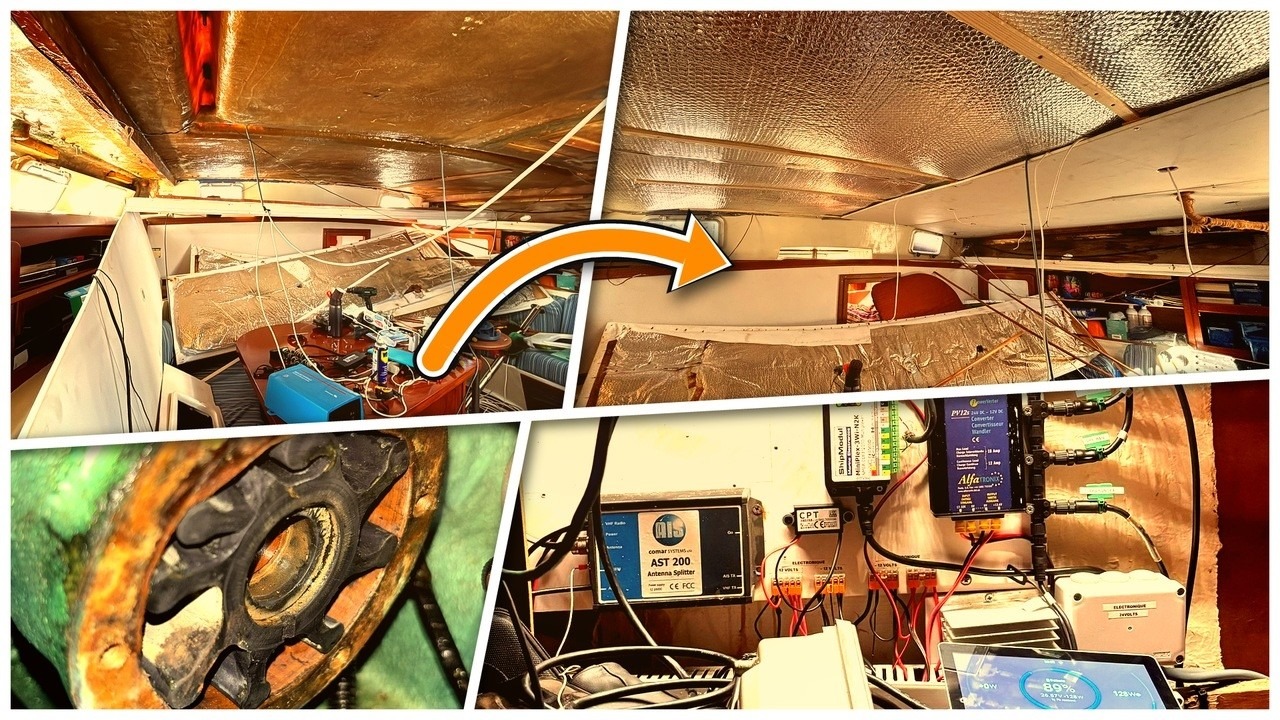
This was the big job of the week. The ceiling panels had been down since the previous visit, and the result was chaos: cables everywhere, a good share of them serving nothing at all.
So the first move was to pull out the dead cables. Several fed equipment that no longer exists on board.
Looking at the structure closely, the underlying problem shows up: every panel batten was screwed straight into the laminate. The result is holes all through the GRP, and a ceiling you cannot take down cleanly.
The answer we settled on, in three layers:
- Thermal insulation in a roll against the deckhead — a 15 m roll cut into 3 m lengths, with offcuts for the joins. In the Mediterranean, what you gain on heat is not a detail.
- Battens fixed over the top, which become the only anchor point.
- The existing panels screwed back into the battens, and never again into the hull.
The first panel went up and held all night — that was the real test. The principle works, so we can roll it out across the rest of the boat.
We are looking for an alternative to the headlining
The original headlining is filthy and full of old screw holes, and replacing it like for like is expensive. We are torn between paint, felt, and stretched fabric — and sure of none of them. If you have already redone yours, we will take any and all feedback, in the comments under the video or through the contact page.
A navigation display for under €50
Alongside the refit, I built a display to replace the commercial multifunction units, which easily run to two or three hundred euros each. Mine comes to under €50.
It was tested on board during the week and shows:
- apparent wind — the angle, the speed, and the 10-minute gust average;
- depth and water temperature;
- speed and GPS data.
Two things still need work: the COG, which is still buggy, and a temperature reading whose source I have not yet identified — the value on screen does not correspond to anything plausible. Both to fix before fitting it for good.
Two jobs that did not get finished
Grey water. Water from the showers and sinks currently goes straight into the bilge, which is neither clean nor sustainable for a long voyage. The idea was to fit a holding tank. The problem: the shower tray appears to be moulded into the structure, and there is no access at all to the bottom of the boat at that point. We need another approach — ideas welcome there too.
The depth sounder. The nasty surprise at the end of the stay: its cable has been cut. So the unit has to be replaced, and it joins the list of equipment described as working that is not. It is exactly the kind of thing we set out in the guide on buying second-hand: believe nothing you have not seen run.
What we take from it
- Pressure switch on the fresh water pump: changed, the system works.
- Impeller on the raw water pump: changed (€58), plus a leaking hose. The engine runs and draws water, not yet at full flow.
- Saloon ceiling: insulation and battens up, the principle is proven.
- Saloon electrical supply: rebuilt.
- Navigation display: tested, working, two fixes to make.
Three days instead of five. The mosquitoes had a lot to do with it, but not everything: the aim is not to put yourself off the work. Shorter, regular visits beat one week too many that leaves a bad memory. There is no hurry; the only annoying part is leaving things half done.
The other lesson is more practical: out here, one missing part costs an hour’s drive to Martigues. The plans still come together too much on the fly. Next time will be prepared before we arrive, and it will be about painting the ceilings.
The refit month by month is in the logbook, the spending is published on the budget page, the countdown is on the departure page, and we sum it all up once a month in the yard letter.