
The video is in French. The whole job is written up in English below.
Half past eleven at night leaving Lyon, two in the morning on board. We were only there for twenty-four hours, and one job could not wait: the depth sounder.
In the previous episode we found the sounder cable had been cut — one more among the six cut cables we have found on board. A dead sounder means hull work, and hull work happens while the boat is ashore. So, now.
Why an Airmar DST820
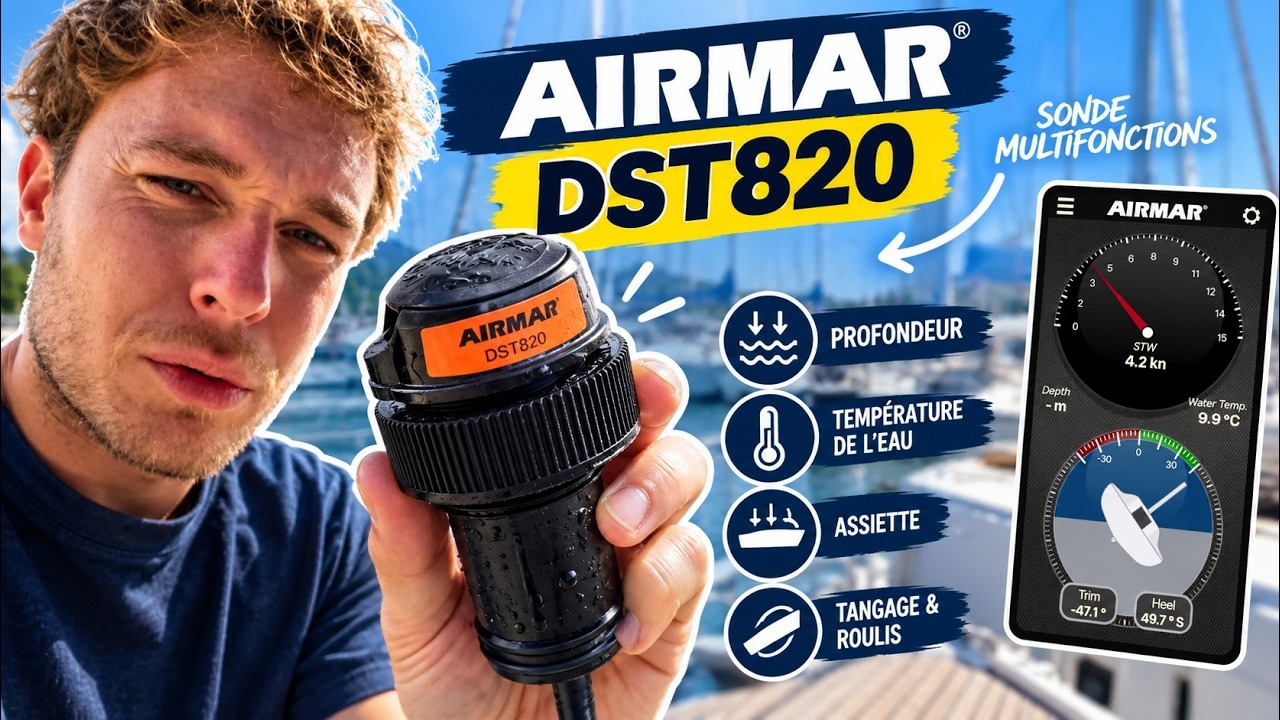
It is a through-hull transducer that takes three measurements in one sensor: depth, speed through the water and water temperature. One hole in the hull instead of three — that is the main argument when you are rebuilding everything anyway.
It connects to the boat’s NMEA 2000 network, the one already feeding the B&G Vulcan display, and it is configured over Bluetooth from a phone, which saves crawling into a locker with a laptop.
The transducer was sent to us by SVB, who have been backing the project for close to a year. We say so because it matters: this kit was not bought. What follows about fitting it, and about what stopped us, is exactly what happened.
The DST820 Smart at SVB ↗ — with the code CQSEVIDENCE, a free item of your choice in the parcel, no minimum order. The partnership is set out on the partners page.
The old skin fitting, or the two-hour job that took a day
The existing hole was far too big for the new transducer, and the tube of the old skin fitting ran up inside the hull. It had to be cut out with an angle grinder, from the inside, because it was bronze.
Thickness nobody builds any more. The fitting was also screwed in and bonded into the laminate, so it came out in pieces. The grinder battery died partway through.
Two hours estimated, a full day in practice. That is the usual ratio on this boat, and it is why we no longer promise schedules by the hour.
Reworking the hole
With the old fitting out, the hole was reworked: opened up very slightly so the new one goes in without forcing, then faired at the edges to get a clean surface back.
Filled and shaped with West System Watertite, mixed one to one. Same product as for the ten skin fittings last winter — the full method is in the skin fittings guide.
What stopped us
The boat has no 230 V on board at the moment, other than from the batteries. No mains, no sanding: the finishing of the skin fitting was left for another weekend.
That is a direct consequence of the electrical rebuild under way, described in the 24 V lithium guide.
The transducer, once configured
The sensor was wired into the NMEA 2000 network and dunked in water for the test — it does not like running dry. Configuration goes through the Airmar Cast app: pick the DST820, tell it the vessel type (sailboat), done.
What it returns straight away: depth, speed, water temperature — 9.9 °C that day — and the heel angle, which we were not looking for and which is a welcome bonus on a sailing boat. The app also shows the NMEA 2000 sentences being sent and their interval.
All of it will then appear on the Vulcan and on the other devices on the network, with no further setup.
What we took away
The electronics took a few minutes. The hull work took the day. On a 1979 boat it is almost always that way round: modern kit goes in quickly, it is removing what was there before that costs the time.
A question for anyone who has done this: to open up a skin fitting hole cleanly in a thick hull, what do you use? We did it with an angle grinder and a file, and there is surely better. Comments are open under the video, or write through the contact page.
The refit month by month is in the logbook, the first-year write-up is on the One year page, the spending is on the budget page, and we sum it all up once a month in the yard letter.
Leave a Reply